
For this project, I started with an anecdotal observation that Chinese restaurants seem to be everywhere, at least one in even the smallest towns.
The Data
I used Python to parse through Foursquare’s open source points of interest via the Huggingface transformers library. From 11GB of data, I isolated over 50,000 Chinese restaurants across Canada and the US. So far, my analysis covers the US and I’ll be adding Canada soon.
In ArcGIS I geoprocessed a combination of census data and the NCES urban/rural classifications with the Chinese restaurant locations.
I mapped populations by race and ethnicity for every census tract. I found a statistically significant spatial autocorrelation (p < 0.001) which shows that Chinese people tend to cluster in the most urban areas, cities and large suburbs.
Despite this, I found that unless you’re in some of the most far-flung places in the US, there’s a Chinese restaurant nearby for you, probably no longer than a five minute drive. It turns out that Chinese restaurants are more correlated with the presence of White populations than Chinese populations.
I determined this by calculating an urban/rural classifications for every census tract, then calculating the distance to the nearest Chinese restaurant from the centroid of each tract.
What’s in a name?
Clearly, the main consumer base for Chinese food across the US is not Chinese people, it’s actually white people.
I was curious if I could track this in a different way—by analyzing the content of restaurant names. Yet another anecdotal observation I had was that the names Chinese restaurants in rural places feel significantly different than those in large cities, especially cities with significant Chinese populations or neighborhoods. In geosemiotics, the meaning of a sign is tied to its physical spot and signals something about its community. Do these restaurant names reflect the different types of audiences and customers to which they’re signaling?
Most linguistic landscape studies are on the small, ethnographic side and focus on the gentrification of specific Chinatowns. I find the tensions between resistance to gentrification and assimilation really interesting. However, I thought it’d be interesting to examine the linguistic landscape on a different scale: across the entire country.
I had a feeling that we are much less likely to find phonetic romanizations in city-based restaurant names, especially in Chinatowns and Chinese enclaves. These are Chinese words that have been transliterated into English sounds.
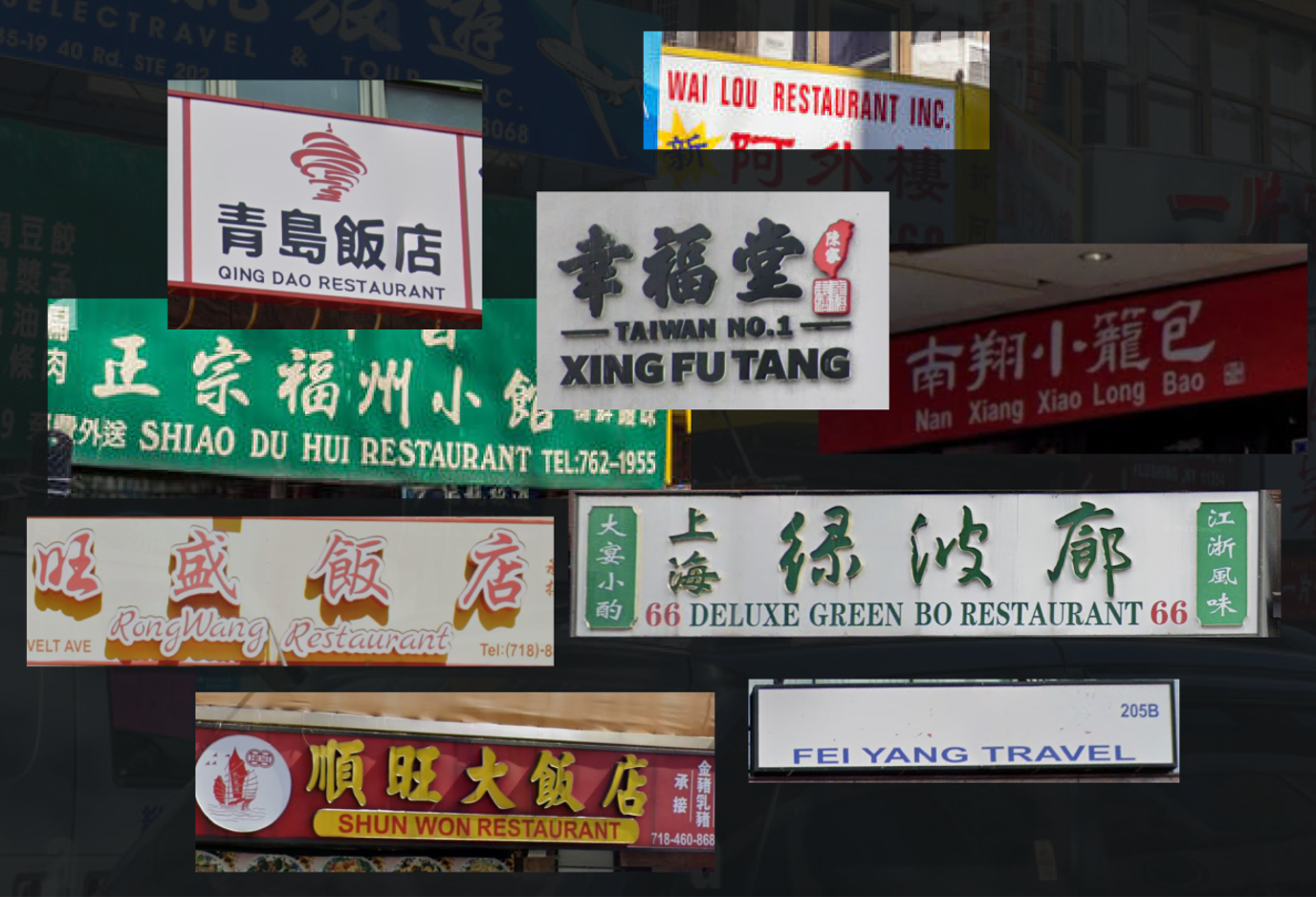
Conducting Text Analysis
I used a combination of computational (in R) and manual, subjective processes to analyze the restaurant names. I cleaned up and tokenized the data into single words and bigrams, setting a threshold for bigram phrases based on a number of parameters such as frequency. From this, I isolated non-English words by matching with an English dictionary, any remainders not matched were assumed to be romanizations.
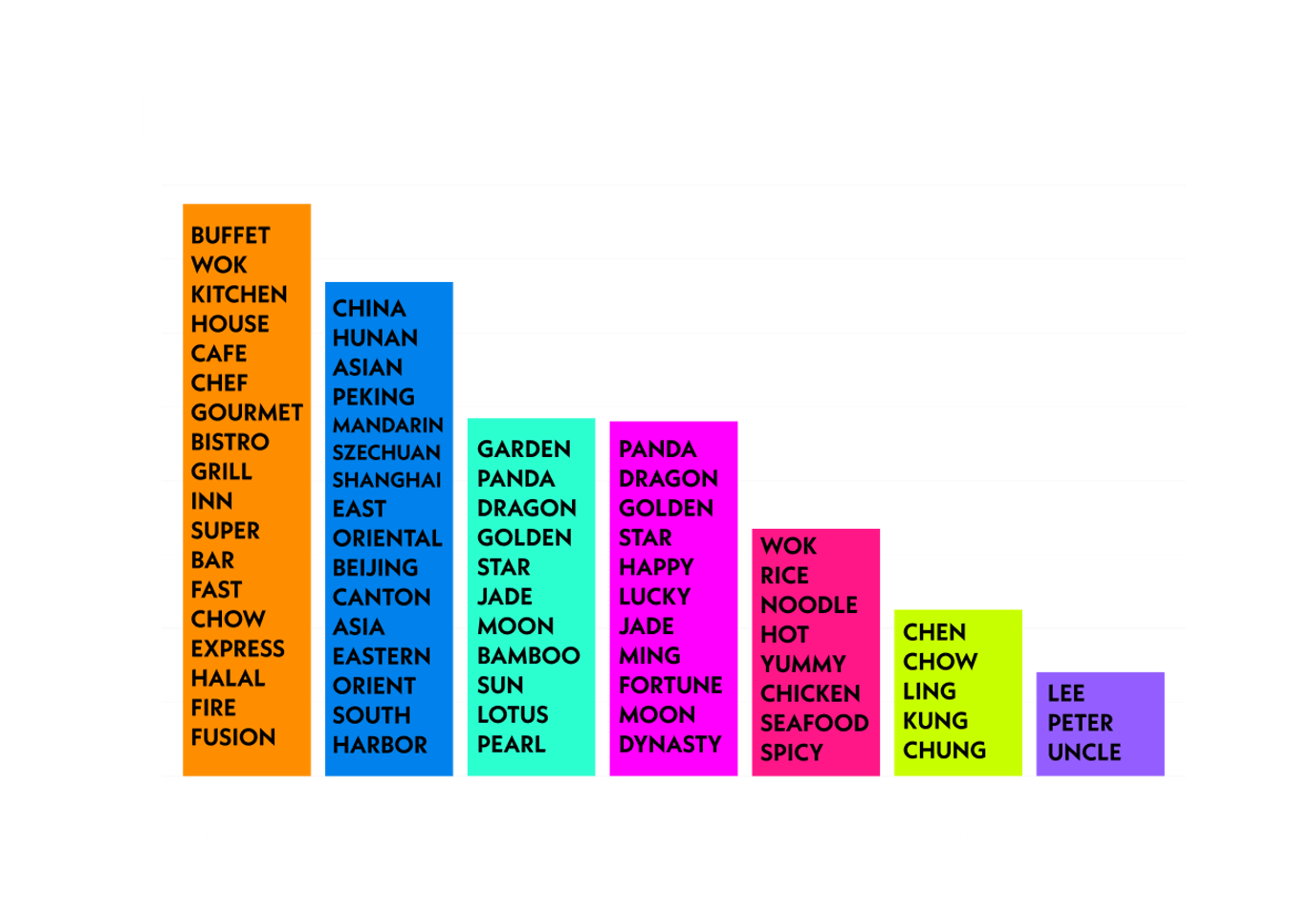
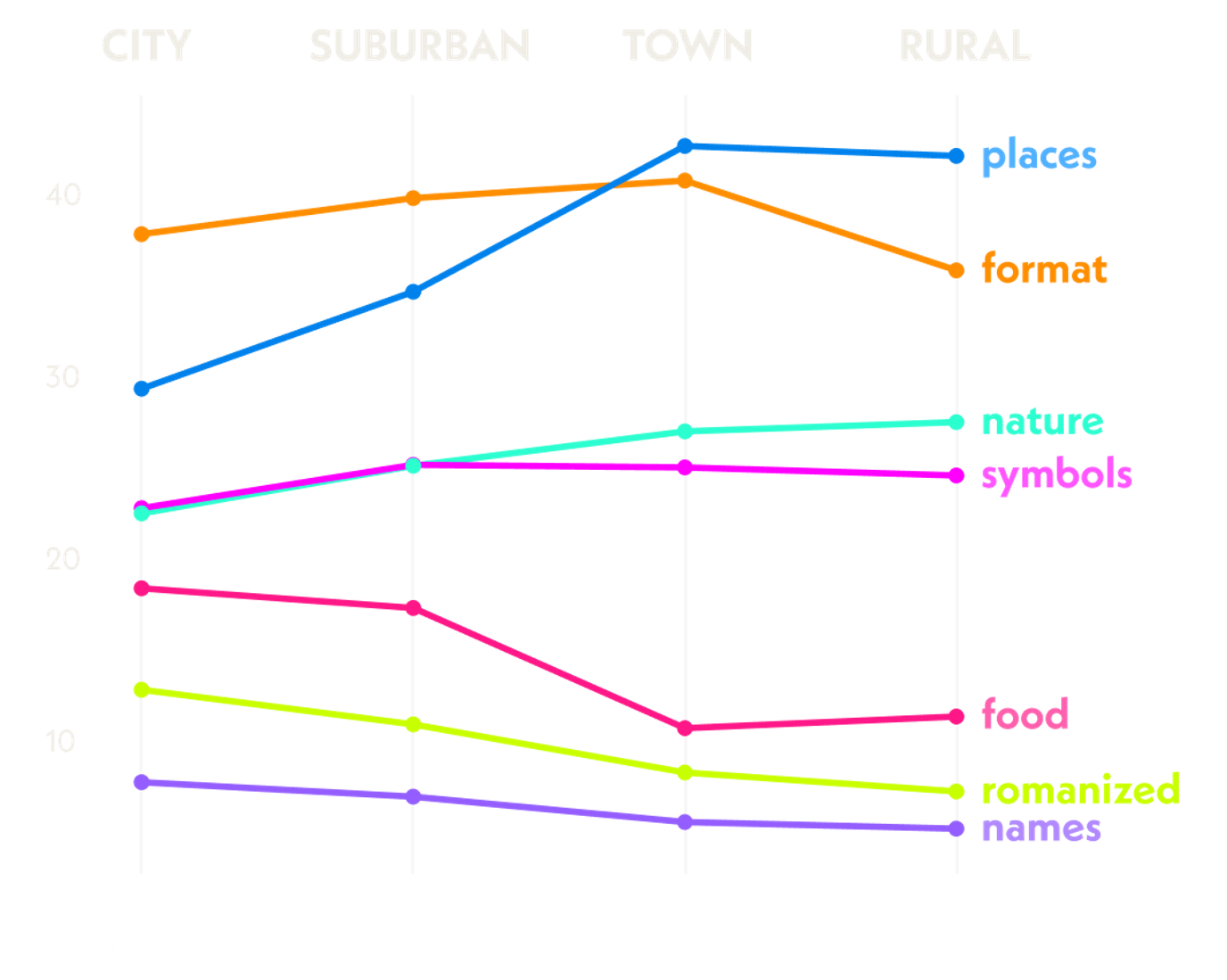
Then, I scanned through the English words (with my eyes) and sorted them into rough semantic categories: relational/indexical (places and names), informational (format and food items), and conceptual (cultural symbols and nature words). The process needs refining because of its manual nature, so not all words were captured (or captured correctly).
Not surprisingly, the most common words fall into the format and place names.
But this differs across the urban-rural spectrum.
I was inspired to create this after seeing a map of every road in Canada. It was fun to attempt mapping all of something, and the map itself is surprisingly fun. When exploring the interactive version, I recommend the random location and random restaurant buttons.
Project information
View the code on GitHub